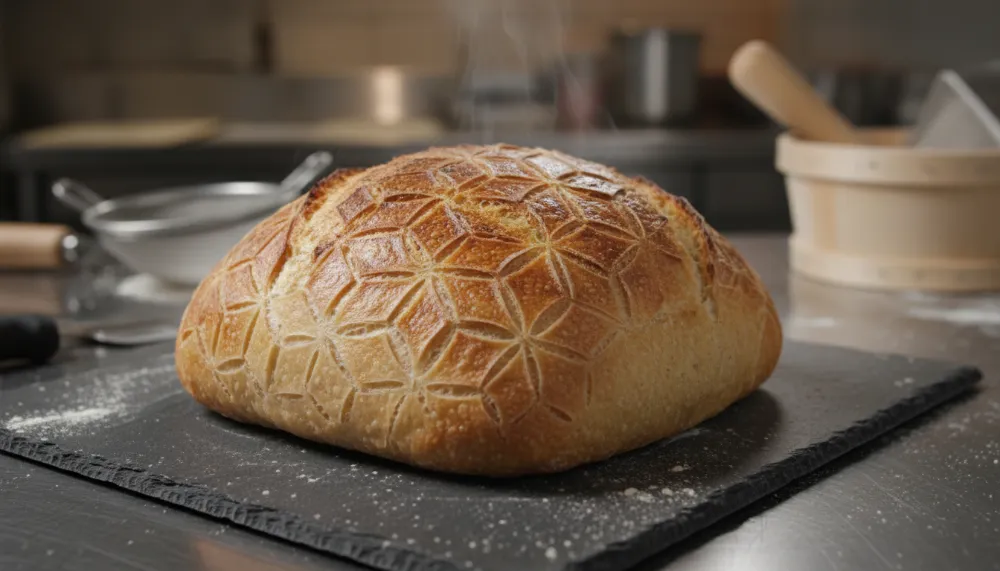

Transform your artisan loaves into stunning gallery-worthy centerpieces with the ultimate guide to Geometric Sourdough Scoring. This precise technique balances the physics of oven spring with the aesthetics of mathematical symmetry to create the perfect crust.
Signature Geometric Garlic & Rosemary Sourdough
Ingredients
- 500g High-protein bread flour
- 350g Filtered warm water
- 100g Active, bubbly sourdough starter
- 10g Fine sea salt
- 50g Roasted garlic cloves (sautéed in vegetable broth)
- 2 tbsp Fresh rosemary, finely chopped
- QTY Rice flour for dusting (prevents sticking during scoring)
Instructions
- 1 Mix the water and active starter in a large bowl until the starter is mostly dissolved.
- 2 Add the bread flour and salt, mixing until a shaggy dough forms. Let rest for 30 minutes.
- 3 Perform 4 rounds of stretch and folds every 30 minutes, incorporating the garlic and rosemary during the second fold.
- 4 Allow the dough to bulk ferment at room temperature until it has increased in volume by 50-75%.
- 5 Shape into a tight boule and place in a proofing basket dusted with rice flour. Refrigerate overnight for 12-15 hours.
- 6 Preheat a Dutch oven to 450°F (230°C). Turn the cold dough onto parchment paper.
- 7 Dust with rice flour and perform your Geometric Sourdough Scoring using a sharp bread lame.
- 8 Bake covered for 20 minutes, then uncovered for 25 minutes until the crust is deep golden brown.
The Art and Physics of Geometric Sourdough Scoring
Geometric Sourdough Scoring is far more than a decorative flair, it is a critical functional element of the bread-making process. When dough enters a hot oven, it undergoes “oven spring,” a rapid expansion caused by the activation of yeast and the vaporization of water into steam. Without intentional cuts, the dough will burst at its weakest points, leading to irregular shapes and dense crumb structures. By applying Geometric Sourdough Scoring, the baker controls this expansion, directing the internal pressure through specific channels to create a uniform, airy interior and a stunning exterior.
The beauty of geometric patterns lies in their symmetry. From simple grids to complex fractals, these designs require a deep understanding of dough tension. A well-shaped boule or batard has a “skin” of tension on the surface. When you score the dough, you are releasing that tension in a controlled manner. Geometric patterns work particularly well because they distribute the expansion evenly across the surface of the loaf, preventing any single area from tearing.
The Historical Evolution of Bread Marks
The history of Geometric Sourdough Scoring is as rich and layered as the bread itself. Research into the art of geometric sourdough scoring reveals a blend of ancient functionality, nutritional science, and modern culinary aesthetics. Long before it was an Instagram trend, scoring served vital social and professional roles.
Ancient Foundations and Medieval Identity
The earliest evidence of scoring dates back to Ancient Egypt, around 1500 BCE. Hieroglyphs and archaeological remains show bakers using sharp tools to create cuts that allowed bread to expand predictably without bursting. These early bakers understood the physics of heat long before modern thermodynamics were codified.
In Medieval Europe, the practice took on a social dimension. Most families did not own private ovens; instead, they used communal ovens owned by the local lord or a professional baker. To identify their specific loaves after they were pulled from the shared fire, each family or baker used unique geometric marks, such as circles, crosses, or specific slashes. This was a primitive form of branding and ownership, ensuring that the high-quality loaf you kneaded at home was the one you took back to your table.
French Tradition and Professional Branding
By the 19th century in France, scoring had evolved into a baker’s signature. Professional bakers in Paris and beyond used geometric precision to track the quality of their batches. Scientists like Vaudry documented the practice as an intersection of art and physics, where the “grigne” (the ear or bloom of the crust) was a mark of a master craftsman. Geometric patterns often carried cultural weight, for instance, the Diamond Crosshatch was a symbol of stability, while the Star represented perfection in the craft.
Nutritional Science: Why Sourdough is Superior
While the exterior of the loaf focuses on Geometric Sourdough Scoring, the interior is a marvel of nutritional science. Sourdough’s long fermentation process significantly alters the nutritional composition of the bread compared to conventional loaves, making it a powerhouse of bioavailability.
The wild yeast and lactic acid bacteria present in the sourdough starter partially pre-digest the flour during the long proofing period. This breakdown of proteins, including gluten, makes the bread significantly gentler on the digestive system for many people. Furthermore, sourdough has a lower Glycemic Index (GI) than standard bread. The organic acids produced during fermentation slow down the rate at which glucose is released into the bloodstream, preventing the sharp insulin spikes often associated with white bread.
Perhaps most importantly, sourdough fermentation neutralizes phytic acid. Phytic acid is an anti-nutrient found in grains that binds to minerals and prevents their absorption. By breaking this down, sourdough makes essential minerals like Iron, Zinc, and Magnesium more bioavailable to the body. A typical 100g serving contains approximately 230 kcal, 8g of protein, and 3g of prebiotic fiber that supports gut health.
Professional Flavor Variations and Substitutions
To master the art of Geometric Sourdough Scoring, you must also master the canvas, the dough itself. Different inclusions can change how the dough behaves during scoring. Below are professional variations that adhere to strict dietary standards, utilizing beef, chicken, or vegetarian alternatives while replacing alcohol with flavorful liquids.
| Variation Name | Key Inclusions | Liquid Enhancement |
|---|---|---|
| Smoked Beef & Sharp Cheddar | Finely diced Beef bresaola or smoked beef strips with aged cheddar. | Beef Broth used for 10% of the hydration. |
| Roasted Garlic & Rosemary | Whole roasted garlic cloves, fresh rosemary, and sea salt. | Vegetable Broth to sauté the garlic. |
| Caramelized Onion & Balsamic | Red onions caramelized with brown sugar. | Balsamic Vinegar and Apple Juice for deglazing. |
| Zesty Jalapeño & Sun-Dried Tomato | Fresh jalapeño slices and oil-packed sun-dried tomatoes (Vegetarian). | Tomato Juice mixed into the water for color. |
| Pesto & Roasted Chicken | Shredded Chicken breast tossed in basil pesto. | Chicken Broth in the dough mix for umami. |
Essential Tools for Geometric Precision
To achieve the sharp, clean lines required for Geometric Sourdough Scoring, you need the right professional tools. Using a standard kitchen knife will often result in jagged edges and dragged dough. Here are the essentials every artisan baker should have in their arsenal:
- The Bread Lame: A specialized handle that holds a razor blade. This allows for the high-precision angles necessary for intricate patterns.
- Rice Flour: Unlike regular flour, rice flour does not brown in the oven. Dusting the top of your loaf with rice flour creates a white canvas that contrasts beautifully with the dark, baked crust, making your Geometric Sourdough Scoring pop.
- Dental Floss or Kitchen Twine: These are excellent for marking out symmetrical quadrants on your dough before you ever touch it with a blade.
- A Precise Sifter: For even distribution of the dusting flour.
Recommended Professional Equipment
- Ninja BN751 Professional Plus DUO Blender: https://amzn.to/3LCDyNR (Why Perfect: 1000W motor, perfect for blending roasted garlic and herbs into a smooth paste for savory doughs).
- Cosori 9-in-1 TurboBlaze Air Fryer 6 Qt: https://amzn.to/4hRWmVq (Why Perfect: Ideal for roasting the garlic or sun-dried tomatoes used in the professional variations).
- Cuisinart 8 Cup Food Processor: https://amzn.to/47Nhbg8 (Why Perfect: Essential for chopping walnuts or shredding beef for inclusions).
- Rubbermaid Brilliance Glass Storage Set: https://amzn.to/4oD0YkY (Why Perfect: Leak-proof storage for keeping your sourdough starter healthy and active).
- FoodSaver Vacuum Sealer Machine: https://amzn.to/4qWgVnS (Why Perfect: Keeps your specialty flours and inclusions fresh longer, preventing oxidation).
Mastering the Patterns: A Step-by-Step Guide
When you are ready to begin your Geometric Sourdough Scoring, remember that depth is key. Deep cuts (about 1/2 inch) will create the primary expansion points, while shallow cuts (1/8 inch) will remain as decorative surface details.
The Diamond Crosshatch
This is the classic geometric pattern. Start by scoring parallel lines across the entire surface of the loaf, spaced about one inch apart. Rotate the loaf 30 to 45 degrees and repeat the process. The resulting diamond grid allows for even expansion across the entire surface, making it one of the most reliable scores for high-hydration doughs.
The Snowflake
Using dental floss, gently press lines into the flour-dusted dough to mark eight symmetrical quadrants. Along each of these axes, use your lame to make small, shallow “V” slashes pointing toward the center. This creates a delicate, fractal-like appearance that is perfect for holiday loaves.
Spiral Geometry
Starting from the exact center of a boule, make a single continuous cut that spirals outward toward the edge. As you move outward, slightly increase the depth of the cut. This creates a shell-like appearance that unfurls beautifully in the oven.
Advanced Tips for Scoring Success
Temperature is your best friend when it comes to Geometric Sourdough Scoring. Always score your dough while it is cold, straight from the refrigerator. Cold dough is firmer and holds its shape better, allowing the blade to glide through without snagging. If the dough is at room temperature, it can be sticky and prone to collapsing under the pressure of the blade.
Furthermore, ensure your dough has sufficient surface tension. During the shaping phase, use the friction of the counter to pull the dough toward you, tightening the outer skin. This tension is what makes the scoring “bloom” in the oven. Without it, your geometric patterns will look flat and dull.
Frequently Asked Questions
Why did my scoring lines disappear?
This usually happens if the dough is over-proofed. When dough is over-proofed, it loses its structural integrity and cannot support the expansion needed to open the scores. Additionally, ensure you are using enough rice flour for contrast.
Can I use a regular razor blade?
Yes, but a bread lame provides a handle that gives you much better control and safety. If using a bare blade, be extremely careful and ensure it is a double-edged stainless steel blade for the cleanest cut.
How deep should I score?
For the primary “expansion” cut, aim for about 1/2 inch deep at a 45-degree angle. For the decorative geometric details, stay very shallow, just barely breaking the surface of the dough skin.