
Mastering the blade is the final step in the journey from dough to masterpiece, where the depth of your cut determines whether your bread will soar or stagnate. Understanding the functional science of Deep vs Shallow Bread Scoring is the difference between a rustic artisan loaf and a kitchen disappointment.
High-Expansion Beef Broth & Herb Boule
Ingredients
- 500g Strong Bread Flour
- 350g Warm Savory Beef Broth
- 10g Sea Salt
- 7g Instant Yeast
- 15g Dehydrated Onion Flakes
- 2 tbsp Beef Drippings (rendered)
Instructions
- 1 Combine the beef broth, yeast, and onion flakes in a large bowl and let sit for 5 minutes.
- 2 Add the flour, salt, and beef drippings, then mix until a shaggy dough forms.
- 3 Knead for 10 minutes until smooth and elastic, then proof in a warm spot for 1 hour.
- 4 Shape into a tight ball (boule) and proof for another 45 minutes on parchment paper.
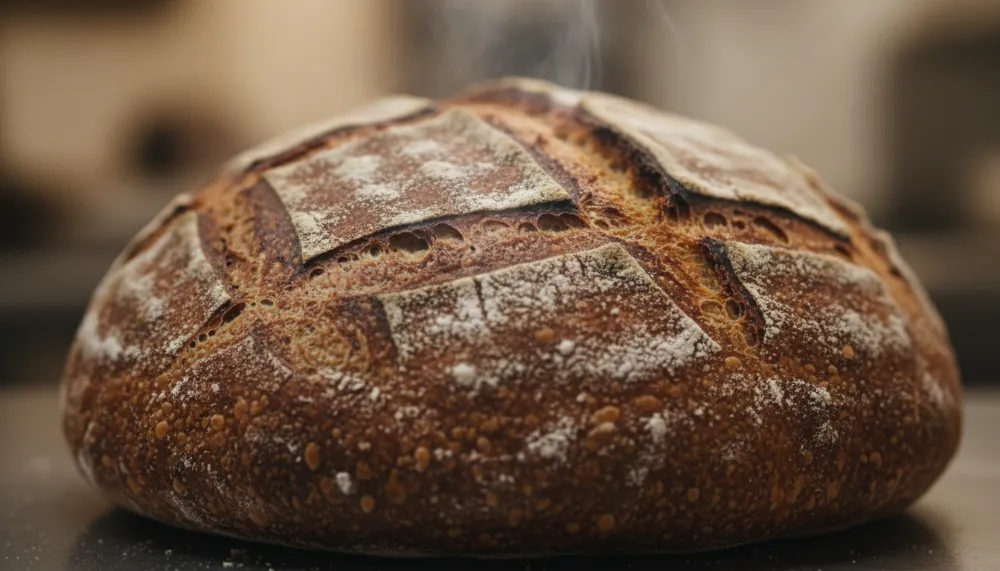
- 5 Use the Deep Scoring technique to cut a 1/2-inch deep cross across the top.
- 6 Bake at 450°F in a preheated Dutch oven for 30 minutes covered and 15 minutes uncovered.
The Fundamental Physics of Deep vs Shallow Bread Scoring
When we talk about Deep vs Shallow Bread Scoring, we are discussing the controlled release of carbon dioxide and steam. As the dough enters the intense heat of the oven, a phenomenon called oven spring occurs. The yeast has one final burst of activity, and the gases inside the dough expand rapidly. Without scoring, the pressure would build up until the dough bursts at its weakest point, usually the bottom or the side, resulting in an asymmetrical, unattractive loaf.
Deep scoring, typically between 1/2 inch and 3/4 inch deep, provides a primary channel for this expansion. It effectively creates a “hinge” that allows the loaf to open up like a blooming flower. This results in a massive volume increase and an open crumb structure. Shallow scoring, on the other hand, refers to surface-level cuts approximately 1/8 to 1/4 inch deep. These are largely aesthetic and do not dictate the overall shape of the loaf as much as they provide decorative texture. In many high-level artisan loaves, both techniques are used in tandem to create a “master cut” for expansion and shallow “etchings” for beauty.
Historical Origins: From Communal Ovens to Culinary Art
The history of bread scoring is as rich as the bread itself. In ancient Egypt, scoring was used to identify different types of grain used in the dough. However, the practice became essential during the Middle Ages in Europe. Because most villagers did not own their own ovens, they took their prepared dough to a communal village oven. To ensure that everyone received their own loaf back, families developed unique scoring patterns, a sort of bread-based family crest. This “trademarking” of bread prevented disputes and ensured quality control.
By the 19th century in France, the *boulangerie* culture elevated scoring to a professional standard. The famous French “ear” (the *grigne*) became a sign of a perfectly proofed and high-steam bake. It required a deep, angled cut with a specialized blade called a lame. Today, the debate over Deep vs Shallow Bread Scoring continues as home bakers experiment with the balance between the functional “ear” and the intricate “wheat stalk” patterns popularized on social media.
Nutritional Impact and the Maillard Reaction
While scoring might seem purely visual, it significantly impacts the nutritional and chemical profile of the bread. Deep vs Shallow Bread Scoring changes the crust-to-crumb ratio and the intensity of the Maillard reaction. A deep score increases the surface area exposed to direct heat, which triggers the Maillard reaction, the chemical interaction between amino acids and reducing sugars. This creates the complex, toasted flavors and dark colors that characterize professional bread.
Furthermore, deep scoring allows for a more thorough bake of the interior crumb. By providing a path for steam to escape, the internal temperature of the bread reaches the necessary 200°F (93°C) more efficiently. This ensures that the starches are fully gelatinized, making the bread easier to digest. Conversely, shallow scoring creates a denser crust that traps more moisture inside, leading to a chewier, more compact crumb, which can be preferable for certain types of rye or dense whole-grain loaves.
Professional Techniques: When to Go Deep
Deep scoring is the gold standard for high-hydration sourdough and lean doughs. If you are using a recipe with heavy ingredients, like our beef-broth-infused boule, deep scoring is non-negotiable. The proteins in the beef broth can create a stronger, more resistant gluten network that needs a significant “vent” to expand properly. Professionals recommend holding the blade at a 45-degree angle for deep cuts to encourage the formation of an ear. If you cut straight down at a 90-degree angle, the dough will simply spread outward rather than lifting upward.
The Art of Shallow Scoring: Decorative Precision
Shallow scoring is where the baker’s personality shines. This technique is often used for intricate patterns like leaves, stars, or even portraits on the bread surface. Because these cuts are shallow, they do not provide the main expansion point for the dough. To successfully use shallow scoring, you must also have a primary expansion cut somewhere on the loaf, or use a dough with lower oven spring potential.
For doughs that use acidic components like apple cider vinegar or balsamic vinegar (excellent replacements for wine in bread making), the gluten is often very extensible. Shallow scoring on these doughs can create beautiful, fine-lined patterns that stay sharp during the bake. To achieve the best results with shallow scoring, bakers often dust the surface of the loaf with flour before cutting, creating a high-contrast look between the white flour and the dark, baked interior of the cuts.
Essential Tools for Bread Scoring Success
To master Deep vs Shallow Bread Scoring, you need the right tools in your kitchen. Here are the professional recommendations for elevating your baking game:
- Ninja BN751 Professional Plus DUO Blender: https://amzn.to/3LCDyNR (Why Perfect: 1000W motor, perfect for creating smooth herb purees or emulsifying beef drippings for savory doughs).
- Cosori 9-in-1 TurboBlaze Air Fryer 6 Qt: https://amzn.to/4hRWmVq (Why Perfect: Excellent for roasting garlic or chicken inclusions for your bread, large family capacity).
- Cuisinart 8 Cup Food Processor: https://amzn.to/47Nhbg8 (Why Perfect: Fast chopping of herbs and savory inclusions, a meal prep essential for artisan bakers).
- Rubbermaid Brilliance Glass Storage Set of 9: https://amzn.to/4oD0YkY (Why Perfect: Perfect for storing your levain or pre-measured dry ingredients, leak-proof and stackable).
- FoodSaver Vacuum Sealer Machine: https://amzn.to/4qWgVnS (Why Perfect: Keeps your specialty flours and dried herbs fresh longer, preventing oxidation).
Savory Inclusions and Scoring Adjustments
In professional baking, the ingredients you add to your dough dictate your scoring strategy. We never use pork in our recipes, but the addition of beef or chicken requires specific adjustments. When incorporating shredded chicken, the dough becomes physically heavier. A deep longitudinal score is required to allow the dough to lift around the protein. If you are using a beef broth reduction for flavor, the added sugars will cause the crust to brown faster, meaning your shallow decorative scores will be more pronounced and require careful timing to avoid burning.
Professional Substitution Chart
| Original Ingredient | Recommended Replacement | Scoring Technique |
|---|---|---|
| Wine | Beef Broth or Vinegar | Deep score to release rich, savory aromas. |
| Pork Bits | Seasoned Beef or Chicken | Deep angled cut to support heavy density. |
| Alcohol Glaze | Honey & Broth Reduction | Shallow scoring after glaze to avoid tearing. |
Common Troubleshooting in Deep vs Shallow Bread Scoring
One of the most common issues in Deep vs Shallow Bread Scoring is the “collapsed loaf.” This happens when the scoring is too deep on a dough that is over-proofed. If the gluten network is already weak, a deep cut will cause the dough to deflate like a balloon. Conversely, if you only use shallow scoring on an under-proofed loaf, the pressure will be so great that the bread will burst at the base, commonly known as “blowouts.”
To avoid these pitfalls, always check your dough’s fermentation level using the finger-poke test. If the dough springs back slowly, it is perfectly proofed for a deep, confident score. If it springs back instantly, it is under-proofed and needs a slightly deeper cut to handle the coming expansion. If it doesn’t spring back at all, it is over-proofed, and you should use very light, shallow scoring to preserve what little structure remains.
Final Thoughts for the Home Baker
The journey of mastering Deep vs Shallow Bread Scoring is one of patience and practice. Every loaf provides a new opportunity to learn how your specific oven, flour, and hydration levels interact with the blade. Remember that even a “failed” score results in delicious, homemade bread. By focusing on the fundamentals of depth, angle, and timing, you will soon be producing loaves that look as good as they taste.