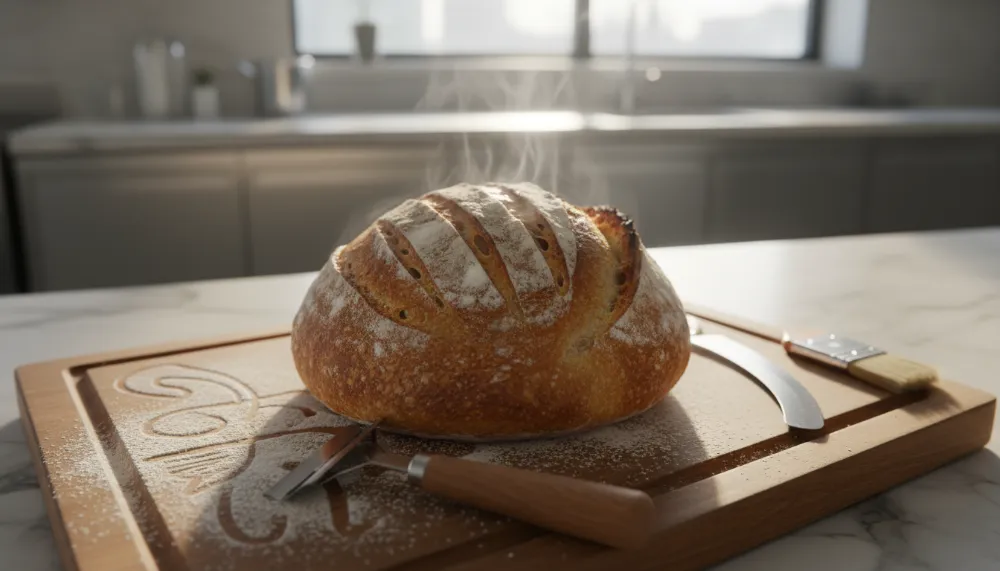

Mastering the art of sourdough scoring is the definitive bridge between a simple homemade loaf and a professional-grade masterpiece that boasts a perfect crust and an impressive ear. This Beginner Sourdough Scoring Guide provides everything you need to transform your baking from basic to breathtaking using simple tools and time-tested techniques.
The Perfect Beginner Sourdough Loaf
Ingredients
- 1 500 grams High-Protein Bread Flour
- 2 375 grams Warm Filtered Water
- 3 100 grams Active Bubbly Sourdough Starter
- 4 10 grams Fine Sea Salt
- 5 Rice Flour (for dusting)
Instructions
- 1 Whisk your starter and water until milky, then mix in flour and salt until a shaggy dough forms.
- 2 Perform 4 rounds of stretch and folds every 30 minutes, then allow to bulk ferment until 50% increase in volume.
- 3 Shape into a tight boule or batard and place in a proofing basket dusted with rice flour.
- 4 Cold proof in the refrigerator for 12 to 24 hours to stiffen the dough for easy scoring.
- 5 Flip onto parchment, dust with rice flour, and follow the scoring guide below for the expansion cut.
- 6 Bake in a preheated Dutch oven at 450F for 20 minutes lid on, and 20 minutes lid off.
The Historical Journey of the Scored Loaf
The history of sourdough scoring is as rich as the bread itself, dating back to the dawn of civilization. While fermentation was discovered by the Ancient Egyptians around 1500 BC, the aesthetic and functional art of scoring became prominent during the Middle Ages in Europe. In Medieval France, villages often shared a single, massive communal oven. To distinguish one family’s loaf from another, bakers would “mark” their dough with a specific signature or slash. This was not just for beauty, it was a matter of ownership and communal organization.
As the centuries passed, French scientists like Vaudry began to study the physics of baking. They realized that these intentional slashes served a critical scientific purpose. When dough hits a hot oven, the gases expand rapidly in a phenomenon known as “oven spring.” Without a pre-determined exit point, the dough would burst at its weakest spot, leading to unsightly ruptures. Scoring provides a controlled path for this expansion, ensuring the bread grows upward rather than outward. This Beginner Sourdough Scoring Guide honors that tradition by blending historical artistry with modern baking science.
The Nutritional Science of Sourdough Fermentation
Beyond the visual appeal of a scored loaf, sourdough offers a nutritional profile far superior to modern commercial breads. The secret lies in the long, slow fermentation process. Unlike quick-rise yeast breads, sourdough relies on wild yeast and lactic acid bacteria. These microorganisms work together to break down phytic acid, an anti-nutrient found in grains that inhibits the absorption of minerals like iron, zinc, and calcium. By neutralizing phytic acid, sourdough makes these essential minerals more bioavailable for your body to absorb.
Furthermore, sourdough acts as a powerful prebiotic. The fermentation process partially pre-digests gluten and other proteins, making it significantly easier on the human digestive tract. It also boasts a lower Glycemic Index, meaning it provides a steady release of energy rather than a sharp spike in blood sugar. For those looking to manage their health while enjoying artisan bread, following this Beginner Sourdough Scoring Guide allows you to create a loaf that is as healthy as it is beautiful.
Professional Flavor Variations: Elevating Your Loaf
Once you have mastered the basics of this Beginner Sourdough Scoring Guide, you can begin to experiment with professional-grade inclusions. Professional bakers use savory additions to create depth and texture. Note that for these variations, we avoid pork and alcohol entirely, focusing on hearty meats and vibrant vegetables.
Savory Beef & Garlic Inclusions
For a robust, meaty loaf, try laminating thin slices of seasoned roast beef into your dough during the final folding stage. To prepare your ingredients, the Ninja BN751 Professional Plus DUO Blender is perfect for creating a smooth garlic and herb paste that can be spread across the dough surface before folding. The result is a savory, marble-like interior that smells incredible as it bakes.
Chicken & Herb Variations
Shredded chicken breast seasoned with rosemary and lemon zest creates a light yet satisfying loaf. Use the Cosori 9-in-1 TurboBlaze Air Fryer to perfectly roast your chicken or even roast whole heads of garlic to fold into the crumb. If you find yourself with extra ingredients, the Rubbermaid Brilliance Glass Storage Set is essential for keeping your inclusions fresh and organized during the long fermentation window.
Vegetarian Artistry
Vegetarian options like sun-dried tomatoes, caramelized onions, and sharp cheddar are classic choices. For the best texture, use the Cuisinart 8 Cup Food Processor to quickly chop large quantities of onions or olives. To ensure your ingredients stay fresh for future bakes, the FoodSaver Vacuum Sealer Machine is a baker’s best friend, preventing freezer burn on delicate herbs or expensive cheeses.
Step-by-Step Technical Guide to Scoring
The technical execution is where most beginners struggle. To achieve that coveted “ear,” you must understand the interaction between temperature, depth, and angle. Here is the core of the Beginner Sourdough Scoring Guide:
1. The Importance of Cold Dough
Trying to score warm dough is like trying to cut a sponge with a butter knife. The dough is too soft and will drag against the blade. By using a long cold proof in the refrigerator, the surface of the dough develops a slight skin and the internal structure becomes firm. This allows your blade to glide through the surface without snagging, resulting in crisp, clean lines.
2. Depth and Pressure
There are two types of scores: expansion cuts and decorative cuts. Your expansion cut must be deep, roughly half an inch, to allow the bread to open. Decorative cuts should be shallow, barely touching the surface. If you make your decorative cuts too deep, they will expand and ruin the overall pattern of the loaf. Use a steady, confident motion, hesitation is the enemy of a clean score.
3. The Angle of the Blade
To get a beautiful ear, you must hold your lame at a 45-degree angle to the dough. Think of it as “tucking” the blade under the surface. This creates a flap of dough that peels back as the loaf expands, forming a crunchy, raised ridge. If you hold the blade at a 90-degree angle (straight up and down), the loaf will open symmetrically like a book, which is also beautiful but will not produce an ear.
Beginner Scoring Patterns to Try
In this Beginner Sourdough Scoring Guide, we recommend starting with four basic patterns that never fail to impress:
- The Crescent: A single long, curved slash from top to bottom. This is the easiest way to get a massive ear on a batard.
- The Cross: Two deep slashes forming a plus sign on a round boule. This allows the bread to expand in four directions.
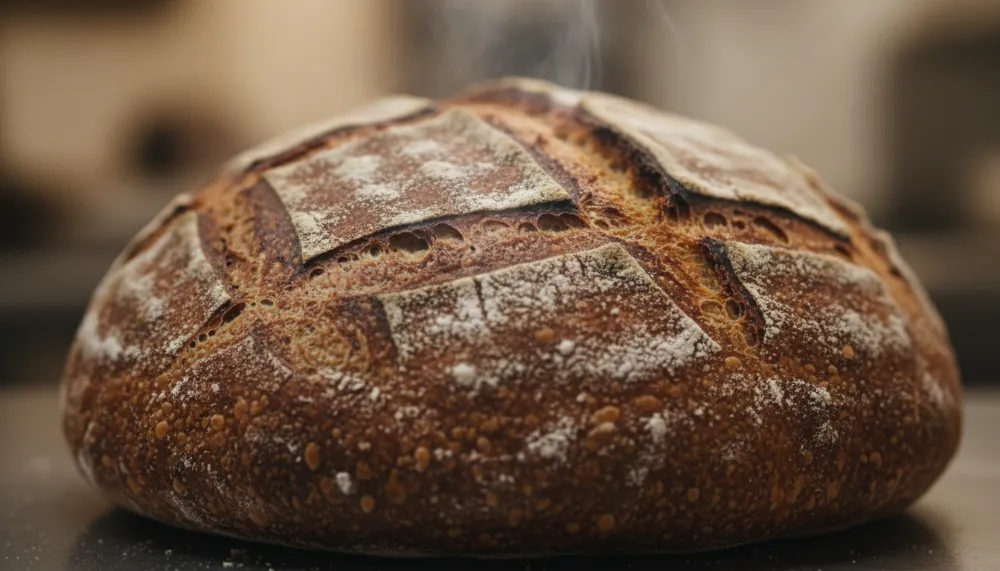
- The Square: Four slashes forming a box on top of the loaf. This creates a “lifting” effect that makes the loaf look very tall.
- The Wheat Stalk: Make one deep expansion slash down the side, then use the tip of the blade to make small, shallow diagonal ticks on the other side.
Troubleshooting Common Scoring Issues
If your scores are disappearing during the bake, your dough is likely over-proofed. Over-proofed dough has lost its structural integrity and cannot hold the tension required for a score to open. Conversely, if your loaf is bursting at the bottom, your expansion score wasn’t deep enough. Practice is the only way to master the feel of the dough, but following this Beginner Sourdough Scoring Guide will significantly shorten your learning curve. Remember to always use a fresh, sharp razor blade for every few loaves to ensure the cleanest possible cuts.